
Finding ants in the pantry or droppings in the garage is stressful, and you want the problem gone fast. But the company you hire matters as much as the treatment. The right pest control company fixes the problem safely, stands behind its work and doesn’t lock you into a contract you’ll regret.
This guide shows you how to choose a pest control company step by step: what to check, what to ask, what it usually costs and which warning signs mean you should keep looking.
What should you look for in a pest control company?
Look for a company that holds a valid state pest control license, carries liability insurance, offers a free or low cost inspection and gives you a clear written plan with pricing and a guarantee. Good companies explain what they found, which products they’ll use and how they’ll keep pests from coming back.
A low price alone shouldn’t decide it. A cheap spray that doesn’t solve the problem means paying twice. Focus on the basics below, and you’ll weed out most of the bad options quickly.
How do I check if a pest control company is licensed?
Every US state requires pest control companies and the technicians who apply pesticides to be licensed or certified. Most states run this through the Department of Agriculture or a similar agency. You can usually search a company or technician by name on that agency’s website in a few minutes.
When you call a company, ask for:
- The company’s state business license number
- The license or certification number of the technician who will treat your home
- Proof of general liability insurance
- Proof of workers’ compensation coverage, if they have employees
If a company hesitates to share any of these, take that as your answer. Licensing rules and lookup tools vary by state, so check your own state agency’s site. [VERIFY your state’s agency name before publishing city or state versions]
Some companies also hold QualityPro certification from the National Pest Management Association (NPMA). It’s voluntary, but it shows the company meets extra standards for training, background checks and business practices.
How much does pest control cost?
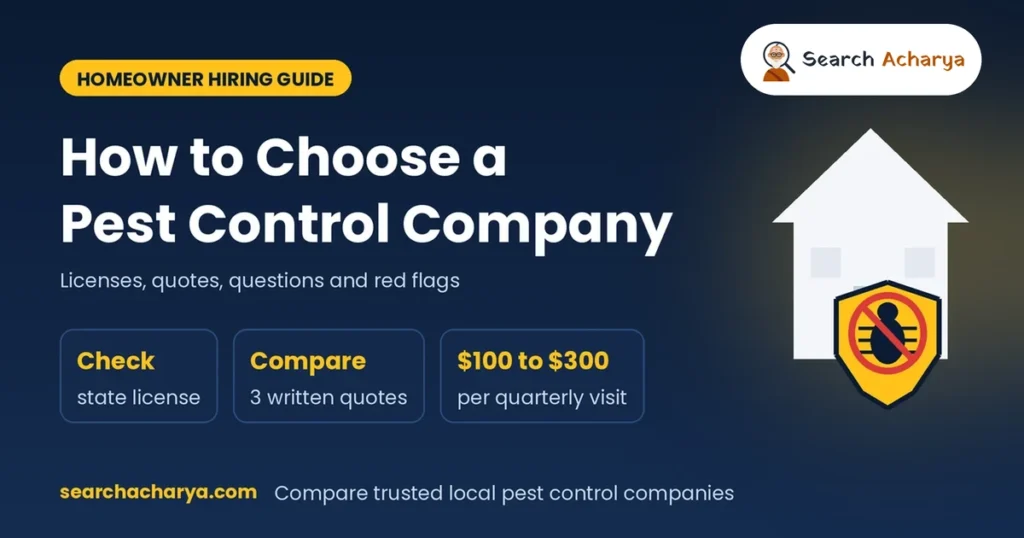
Most homeowners pay $200 to $600 to deal with a typical pest problem. Ongoing plans usually start with an initial visit of $150 to $300, followed by quarterly visits of $100 to $300 each. Prices vary by pest type, home size, location and how serious the infestation is.
Here are typical US price ranges:
One time treatment: $300 to $550
Initial visit for an ongoing plan: $150 to $300
Monthly service: $40 to $70 per visit
Quarterly service: $100 to $300 per visit
Ants: $100 to $500
Cockroaches: $100 to $400
Rodents: $180 to $540
Termites: $230 to $940 for many treatments, and more for large or tented jobs
Bed bugs: $300 to $5,000, depending on the number of rooms and method
Mosquitoes: $70 to $1,900, depending on how many treatments you need in a season
Wildlife removal: $255 to $600
These are general estimates. Your actual price depends on your area, the size of your home and the scope of the work.
What questions should you ask a pest control company?
Ask what pest they identified, how they’ll treat it, which products they’ll use, how many visits it will take, what the guarantee covers and how much the full plan costs in writing. A trustworthy technician answers clearly and doesn’t rush you into signing.
Keep this list handy when you call or when the technician visits:
- What exactly is the pest, and how bad is the infestation?
- What’s causing it, and how are they getting in?
- What treatment do you recommend, and why?
- Which products will you use? Are they EPA registered?
- Are the products safe around kids, pets and anyone with allergies or asthma once they dry?
- Do I need to leave the house, and for how long?
- How many visits will this take?
- What does your guarantee cover? Will you come back for free if pests return between visits?
- Is there a contract? How long is it, and how do I cancel?
- What will I pay in total, including the first visit?
Write down the answers. They make it much easier to compare companies side by side.
What is Integrated Pest Management (IPM)?
Integrated Pest Management, or IPM, is an approach that combines inspection, prevention and targeted treatment instead of spraying chemicals on a fixed schedule. An IPM company finds where pests enter and why they’re there, seals gaps, removes food and water sources and uses the least toxic product that works.
Ask any company you’re considering whether they follow IPM. It usually means fewer chemicals in your home, longer lasting results and a technician who actually looks around instead of spraying and leaving. If you have small kids, pets or a family member with health concerns, IPM is a smart choice.
Should you sign a pest control contract?
A contract makes sense for ongoing pests like ants, roaches, termites or rodents in areas where they keep coming back. For a single issue, such as one wasp nest, a one time service is usually enough. Before signing, read the term length, cancellation rules, price increases and what the guarantee includes.
Look for these details in writing:
- The length of the agreement, such as 12 months
- How often the technician will visit
- Which pests are covered and which aren’t
- Whether free return visits are included between scheduled treatments
- How much notice you need to give to cancel, and whether there’s a fee
- Whether the price can go up at renewal
Termite plans deserve extra attention. Ask whether the warranty is a “retreatment only” plan or one that also helps pay for repairs if termites cause new damage. The difference can be worth thousands of dollars.
What are the red flags when hiring a pest control company?
Be cautious of companies that knock on your door uninvited, pressure you to sign today, won’t share a license number, quote a price without inspecting, ask for full payment upfront or claim to use a secret product nobody else has. These are common signs of a scam or a low quality operator.
Other warning signs include:
- No written estimate or contract
- Cash only payment
- A price that’s far lower than every other quote
- Vague answers about which products they use
- No physical business address or online reviews
- Scare tactics, like saying your house will collapse unless you sign now
Door to door pest control sales are common in many US neighborhoods during spring and summer. Some are legitimate, but it’s always fine to say, “Leave me your information, and I’ll compare.” A good company won’t mind.
How do you compare pest control companies?
Get at least three quotes from licensed local companies, then compare the inspection, treatment plan, products, number of visits, guarantee and total price. Read recent reviews for patterns, not just star ratings. The best value is usually the company with a clear plan and a strong guarantee, not the lowest number.
When you read reviews, look for comments about:
- Whether the problem actually went away
- How the company handled callbacks
- Whether technicians showed up on time
- Surprise charges or billing problems
- How easy it was to cancel
On Search Acharya, you can browse local pest control companies in your city, check their hours and contact details and read reviews in one place. It’s a quick way to build your shortlist before you start calling.
When should you call a professional instead of doing it yourself?
DIY works for small, occasional problems like a few ants near the kitchen sink. Call a professional for termites, bed bugs, rodents inside walls, stinging insects near entry points, wildlife or any problem that returns after you’ve treated it. These pests spread fast and can cause damage or health risks.
Professionals also have access to tools and products you can’t buy at a hardware store, and they’re trained to apply them safely. If you’ve already spent money on store sprays and traps without results, a professional inspection is often the cheaper path from here.
How to Prepare for Your First Pest Control Visit
A little preparation helps the treatment work better and saves time.
- Write down where and when you’ve seen pests.
- Clear access to baseboards, under sinks, the garage and the attic.
- Store food, dishes and pet bowls away from treatment areas.
- Ask whether pets and family members need to stay out, and for how long.
- Fix leaks and remove clutter where pests can hide.
- Keep the paperwork, including product names, for your records.
Frequently Asked Questions
How often should you get pest control?
Most homes do well with quarterly service, which means four visits a year. Homes in warm, humid areas or with an active problem may need monthly visits at first. Your technician should recommend a schedule based on what they find during the inspection.
Is pest control safe for kids and pets?
Most treatments are considered safe once products dry or settle, when applied by a licensed technician following the label. Always ask which products will be used and how long kids and pets should stay away. Companies that follow IPM tend to use fewer and more targeted products.
Do pest control companies offer free inspections?
Many do, especially for general pests and termites. Some charge a small inspection fee that’s credited toward the treatment if you hire them. Ask about any inspection fee when you schedule the visit.
How long does pest control take to work?
You may notice fewer pests within a few days, but many treatments take 2 to 4 weeks to fully work. Bed bugs, termites and rodents often need several visits. Seeing a few pests right after treatment is normal as they come out of hiding.
Can I cancel a pest control contract?
Most contracts can be canceled, but the terms vary. Some require 30 days’ written notice, and some charge a fee for ending early. Read the cancellation section carefully before you sign.
What’s the difference between an exterminator and a pest control company?
The terms are often used the same way. “Exterminator” usually refers to the technician who removes pests, while a pest control company may also offer prevention, inspections and long term protection plans.
Do I need a termite inspection when buying a home?
Many lenders, especially for VA loans and in states with heavy termite activity, require a wood destroying insect inspection before closing. Even when it isn’t required, it’s a smart step that usually costs far less than termite repairs. [VERIFY lender requirements for specific states]
Final Thoughts
Choosing a pest control company comes down to a few simple checks: a valid license, proper insurance, a real inspection, a clear written plan and a guarantee you understand. Compare a few local companies, ask the right questions and don’t let anyone rush you.
When you’re ready to start, browse licensed pest control companies near you on Search Acharya. Compare services, hours and reviews, then reach out to two or three providers for a quote.