
The fastest way to find authentic Korean restaurants in Los Angeles is to start in Koreatown, look for places that focus on one or two signature dishes, and check whether Korean families are eating there. Los Angeles County has the largest Korean population outside of Korea, so you have hundreds of real options. The trick is knowing which signs to trust.
This guide covers where to look, what authentic Korean food actually is, what you should expect to pay, and the red flags that point to a tourist trap. You’ll also learn how to use Search Acharya to compare local restaurants, hours and reviews before you go.
What makes a Korean restaurant authentic?
An authentic Korean restaurant cooks food the way it’s made in Korea, for a crowd that knows how it should taste. You’ll usually see a focused menu, free side dishes called banchan, house made kimchi, Korean language signs or menus, and a dining room full of Korean speaking regulars. Fusion spots can be great, but they aren’t the same thing.
Banchan are the small side dishes served free with your meal, such as kimchi, seasoned spinach, bean sprouts, pickled radish and fish cake. At a traditional restaurant, they arrive before your main dish and refills are normally free. Ask your server politely and they’ll bring more.
Authenticity also shows in the details. Rice often comes in a lidded stainless steel bowl, metal chopsticks and a long spoon sit in a box on the table, and many places have a call button so you can ring for your server. None of these alone proves anything, but together they tell you the kitchen is cooking for people who grew up with this food.
Where are the best areas for authentic Korean restaurants in Los Angeles?
Koreatown is the heart of authentic Korean restaurants in Los Angeles, especially the blocks along Wilshire Boulevard, 6th Street, Olympic Boulevard and Western Avenue between Vermont and Western. Strong Korean food scenes also exist in Torrance, Gardena, Cerritos, Rowland Heights and La Crescenta, plus Garden Grove and Buena Park in nearby Orange County.
Koreatown (central Los Angeles)
Koreatown is roughly bounded by Vermont Avenue, Western Avenue, 3rd Street and Olympic Boulevard [VERIFY]. It’s one of the densest neighborhoods in the county, and many restaurants stay open late, some past midnight. Parking is tight, so look for strip mall lots, valet service or the Metro D Line stations at Wilshire/Vermont, Wilshire/Normandie and Wilshire/Western.
South Bay: Torrance and Gardena
The South Bay has a large Korean community and plenty of family run restaurants in strip malls. Parking is easier than in Koreatown, crowds are smaller, and you’ll find good soup houses, tofu stew spots and Korean bakeries.
San Gabriel Valley, Cerritos and the Foothills
Rowland Heights, Diamond Bar and Cerritos have Korean shopping plazas with food courts and casual restaurants. La Crescenta and Montrose, near Glendale, have a smaller but well established Korean community with quieter, neighborhood style spots.
What dishes should you order at an authentic Korean restaurant?
Order the dish the restaurant is known for. Many authentic Korean restaurants in Los Angeles specialize in one style of cooking, such as barbecue, soft tofu stew, cold noodles or ox bone soup. A place that does one thing well is usually a better bet than a place with a 12 page menu covering everything.
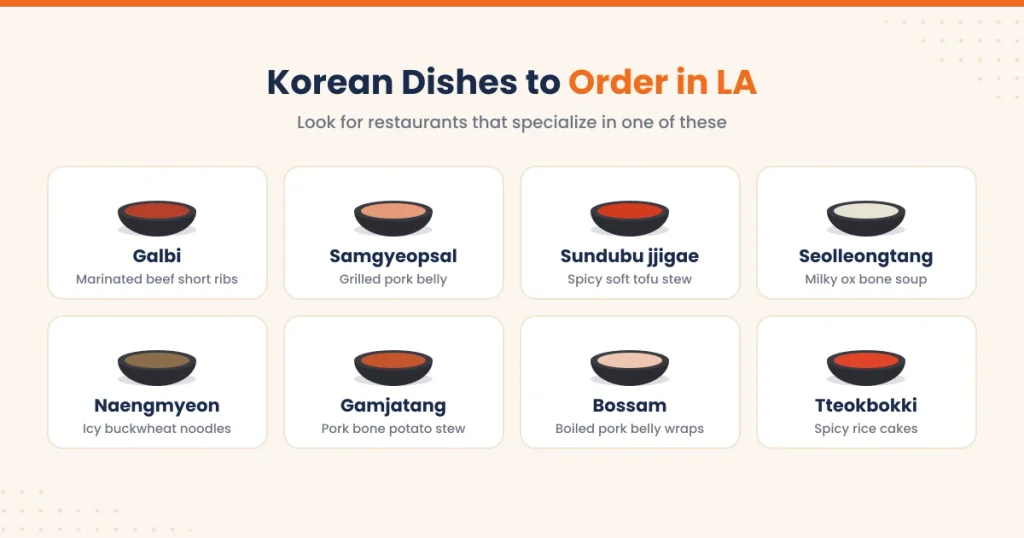
| Dish | What it is | Where to look |
|---|---|---|
| Galbi | Marinated beef short ribs grilled at your table | Korean BBQ restaurants |
| Samgyeopsal | Thick slices of unmarinated pork belly, grilled and wrapped in lettuce | Pork focused BBQ spots |
| Sundubu jjigae | Spicy soft tofu stew served bubbling in a stone pot | Tofu houses |
| Seolleongtang | Milky ox bone soup you season yourself with salt and green onion | Soup specialists |
| Naengmyeon | Chewy buckwheat noodles in icy beef broth | Noodle houses, great in summer |
| Gamjatang | Pork bone and potato stew, often shared | Late night stew spots |
| Bossam and jokbal | Boiled pork belly and braised pork trotters | Specialty pork restaurants |
| Tteokbokki and kimbap | Spicy rice cakes and seaweed rice rolls | Snack shops (bunsik) and food courts |
If a restaurant’s name includes the dish, such as “tofu house” or “naengmyeon,” that’s usually a good sign. Korean diners often pick a restaurant by craving, not by cuisine.
How much does Korean food cost in Los Angeles?
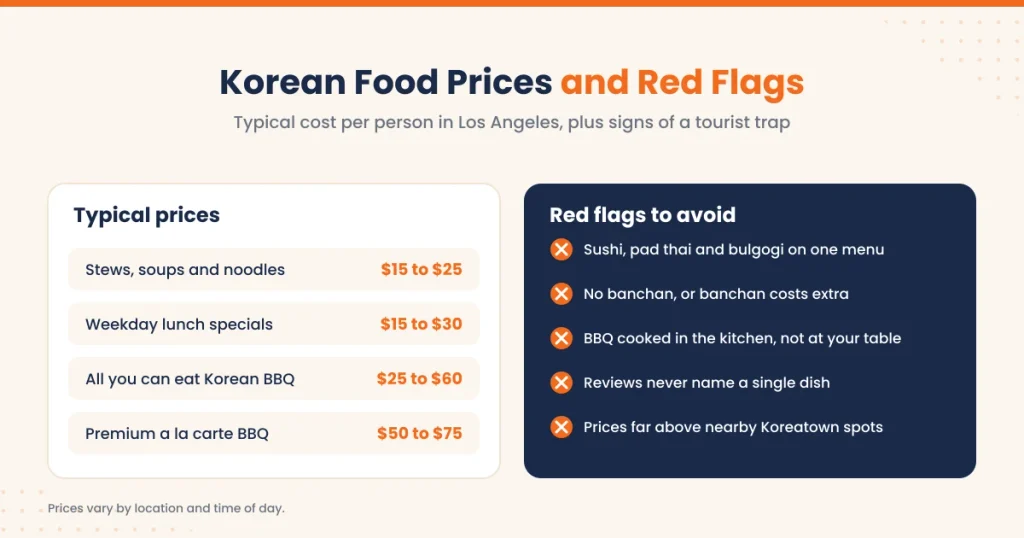
At most authentic Korean restaurants in Los Angeles, a meal costs about $15 to $25 per person for soups, stews and noodles. All you can eat Korean BBQ usually runs about $25 to $60 per person depending on the tier and time of day, while premium a la carte barbecue often lands around $50 to $75 per person before drinks and tip. Prices vary by location.
| Type of meal | Typical price per person |
|---|---|
| Stews, soups and noodle dishes | $15 to $25 [VERIFY] |
| Weekday lunch specials | $15 to $30 |
| All you can eat Korean BBQ | $25 to $60 |
| Premium a la carte Korean BBQ | $50 to $75 |
| Snack shop meals (kimbap, tteokbokki) | $10 to $18 [VERIFY] |
Lunch is the cheapest time to try a pricey barbecue place. Also check the bill for a service charge. Some Los Angeles restaurants add an automatic fee or gratuity, especially for large groups, so read the menu before you tip again.
How can you tell if a Korean restaurant is authentic before you go?
Check the menu, the photos and the reviews before you visit any of the authentic Korean restaurants in Los Angeles you’re considering. Real Korean restaurants usually list dishes by their Korean names, show banchan in customer photos, and get reviews that mention specific dishes like sundubu or galbi. If the reviews only talk about the decor or the cocktails, the food may be an afterthought.
- Read the menu online. Look for Korean dish names with English descriptions, a short list of specialties and Korean drinks like soju and makgeolli (a milky rice wine).
- Look at customer photos. You want to see banchan on the table, stone pots, metal rice bowls and gas or charcoal grills with overhead vents.
- Scan the reviews for detail. Helpful reviews mention broth, kimchi quality, meat cuts and whether banchan refills are free.
- Search in Korean. Typing the dish name in Korean into a map app often surfaces places popular with Korean speakers.
- Compare on Search Acharya. Use the directory categories to compare hours, phone numbers, reviews and directions for Korean restaurants near you.
What are the red flags of a tourist trap Korean restaurant?
Watch out for huge menus that mix Korean, Japanese and Chinese food, no banchan or banchan that costs extra, and reviews that rarely name a dish. Bottled kimchi tasting identical to the grocery store kind, a dining room with no Korean speaking guests, and pushy upselling are other common warning signs.
- The menu has sushi, pad thai and bulgogi all on one page.
- Banchan is missing, tiny, or charged as an extra.
- The “Korean BBQ” is cooked in the kitchen and served on a plate.
- Reviews mostly praise the music or the photo spots.
- Prices are far above nearby Koreatown restaurants for the same dishes.
Fusion isn’t bad, and plenty of authentic Korean restaurants in Los Angeles sit right next to creative newcomers. The city is famous for Korean tacos and inventive Korean American cooking. Just know what you’re getting, and go to a traditional spot when you want the real thing.
What should you know about Korean dining etiquette?
Korean dining is built for sharing, and a few simple habits will make you feel at home in authentic Korean restaurants in Los Angeles. Dishes go in the middle of the table, everyone picks from the banchan, and at barbecue restaurants the server may cook the meat for you or you’ll grill it yourself. Pour drinks for others before yourself, and turn your head slightly when drinking with someone older as a sign of respect.
- Don’t stick chopsticks upright in rice. It looks like an offering at a funeral.
- Wrap your barbecue. Put meat, garlic and ssamjang (a thick dipping paste) in a lettuce leaf and eat it in one bite.
- Know the time limit. All you can eat barbecue often has a 90 minute to 2 hour limit, and some places charge for large amounts of leftover meat.
- Tip like any US restaurant. 18% to 20% is typical unless a service charge is already on the bill.
When is the best time to visit authentic Korean restaurants in Los Angeles?
Weekday lunch is the best time for short waits and lower prices. Friday and Saturday nights in Koreatown can mean waits of 40 minutes to over an hour at popular barbecue spots. Late night is also a good option, since many Koreatown restaurants serve food well after other neighborhoods close.
Soup and stew houses are busiest in cooler months, while naengmyeon spots fill up on hot summer days. Call ahead to ask about reservations, since many barbecue restaurants only take bookings for larger groups.
How Search Acharya helps you find authentic Korean restaurants in Los Angeles
Search Acharya is a free local business directory for the USA where you can browse restaurants by category or explore local businesses in Los Angeles. Before you drive across town to one of the authentic Korean restaurants in Los Angeles, check a restaurant’s hours, phone number, reviews and directions in one place. Every listing is reviewed before it goes live.
Own a Korean restaurant in Los Angeles? You can list your business for free and help hungry locals find your kitchen.
Frequently asked questions
Where is the best place to find authentic Korean restaurants in Los Angeles?
Koreatown in central Los Angeles has the highest concentration of authentic Korean restaurants in Los Angeles. Torrance, Gardena, Cerritos, Rowland Heights and La Crescenta are also strong choices. Garden Grove and Buena Park in Orange County are worth the drive too.
Is Korean BBQ the most authentic Korean food?
Korean BBQ is authentic, but it’s only one part of Korean cuisine. Everyday Korean meals lean more on stews, soups, rice and banchan. Try a tofu house or an ox bone soup restaurant for a fuller picture.
What is banchan and is it free?
Banchan are small side dishes such as kimchi, seasoned vegetables and fish cake served with your meal. At most traditional Korean restaurants, banchan and refills are free. If a place charges for basic banchan, that’s unusual.
How much should I budget for Korean BBQ in Los Angeles?
Plan on about $25 to $60 per person for all you can eat Korean BBQ, plus drinks and an 18% to 20% tip. Premium a la carte spots often cost $50 to $75 per person. Lunch specials are the cheapest way to try a higher end restaurant.
Do Korean restaurants in Koreatown stay open late?
Many Koreatown restaurants stay open late, and some serve food past midnight. Hours change often, so check the listing before you go. Search Acharya shows hours and phone numbers so you can confirm quickly.
Do I need a reservation for Korean restaurants in Los Angeles?
Many casual Korean restaurants don’t take reservations and seat walk ins. Popular barbecue spots may accept bookings for groups, and weekend waits can be long. Calling ahead is the easiest way to know.
Are there vegetarian options at Korean restaurants?
Yes, but you need to ask. Dishes like bibimbap, vegetable pancakes and tofu stew can often be made without meat, though many broths and kimchi contain fish sauce or seafood. Tell your server about your diet before you order.