
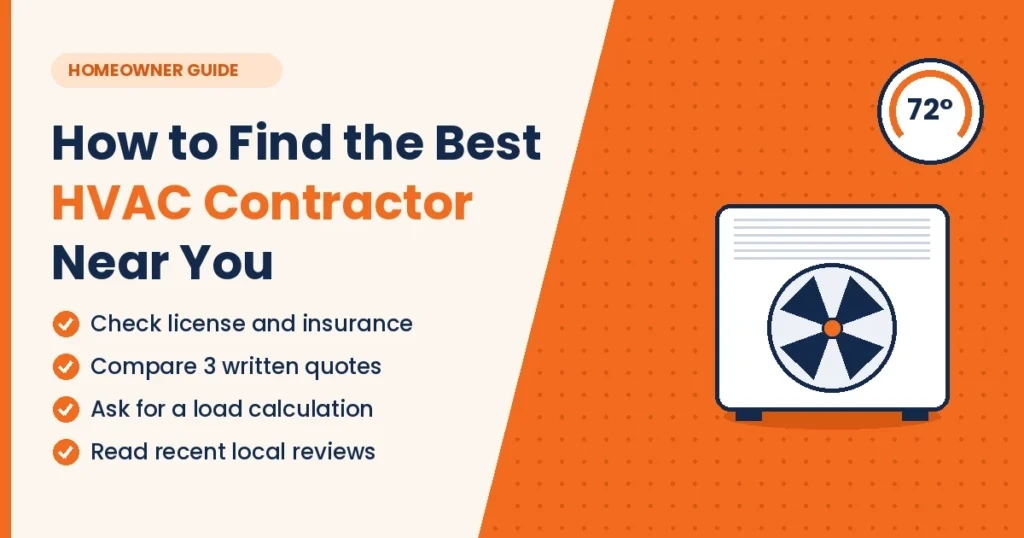
The best way to find a good HVAC contractor near you is to build a short list of local companies, check each one’s license and insurance, read recent reviews, and compare at least three written quotes after an in home visit. That process takes a few days, and it protects you from overpaying or getting the wrong system.
Your heating and cooling system is one of the most expensive things in your home to repair or replace. This guide shows you exactly what to check, what to ask, what a fair price looks like, and which warning signs mean you should keep looking.
What does an HVAC contractor do?
An HVAC contractor is a licensed company or technician that installs, repairs and maintains heating, ventilation and air conditioning equipment. That includes furnaces, central air conditioners, heat pumps, ductless mini splits, ductwork, thermostats and indoor air quality products like air purifiers and humidifiers.
Some HVAC companies focus on homes, while others mainly serve commercial buildings. Many also offer 24/7 emergency service and yearly maintenance plans. When you hire, look for a residential HVAC contractor that works on the type and brand of system you already have or want to install.
How do I find a good HVAC contractor near me?
Start with three to five local HVAC companies that have steady, recent reviews. Then verify each one’s state license, EPA certification and insurance, ask for an in home evaluation, and compare detailed written quotes. Choose the contractor who explains the work clearly, not simply the lowest price.
Here are the eight steps in order.
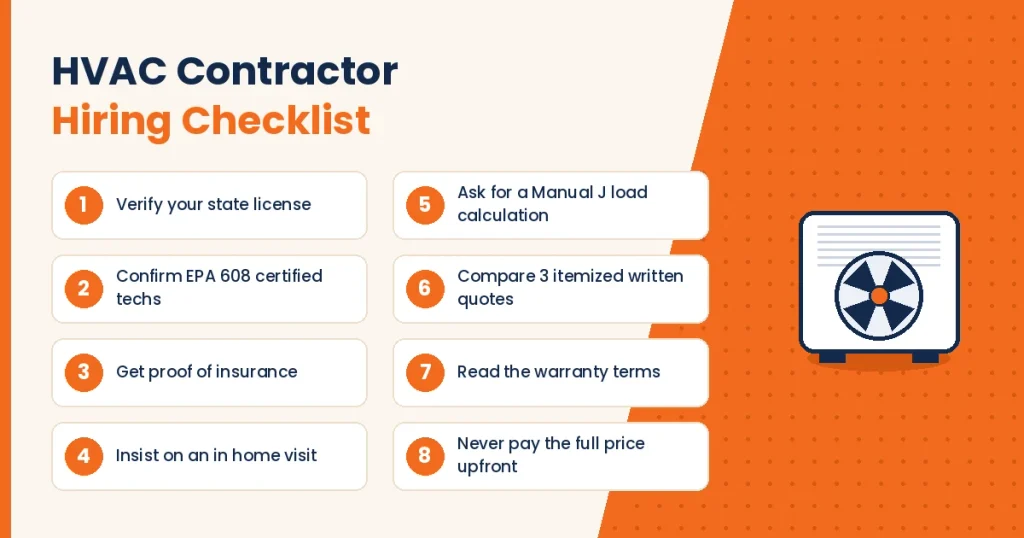
1. Build a short list of local HVAC companies
Look for companies based close to you. A local HVAC contractor can usually reach you faster in an emergency and knows your climate, local codes and permit process. You can compare HVAC contractors on Search Acharya to see hours, phone numbers, reviews and directions side by side.
Ask neighbors, friends and coworkers who they’ve used, too. A personal referral paired with good online reviews is a strong starting point.
2. Check the contractor’s license
Most states require HVAC contractors to hold a state license, while some states leave licensing to cities or counties. Look up the license number on your state licensing board’s website and confirm it’s active and in the company’s name. Rules vary by state, so check what yours requires. [VERIFY for target state]
3. Confirm EPA Section 608 certification
Federal law requires technicians who handle refrigerant to hold EPA Section 608 certification. Any technician who charges, recovers or works on the refrigerant in your air conditioner or heat pump needs it. Ask the company to confirm its technicians are certified.
You may also see NATE certification. NATE (North American Technician Excellence) is a voluntary industry certification that shows a technician passed tests on specific equipment. It isn’t required, but it’s a good sign.
4. Verify insurance and bonding
Ask for a certificate of insurance showing general liability coverage and workers’ compensation. If an uninsured worker gets hurt in your attic or damages your home, you could end up paying for it. Some states also require HVAC contractors to carry a surety bond.
5. Read reviews the smart way
Don’t just look at the star rating. Read the most recent reviews and look for patterns. Do customers mention clean work, on time arrivals and honest pricing? How does the company respond to complaints?
A handful of unhappy reviews is normal for a busy company. A steady stream of complaints about surprise charges or no shows is not.
6. Insist on an in home evaluation and load calculation
A good HVAC contractor won’t quote a new system over the phone or simply match the size of your old unit. They’ll visit your home and measure it. For replacements, ask for a Manual J load calculation. Manual J is the industry standard method, published by ACCA (Air Conditioning Contractors of America), for figuring out how much heating and cooling a home actually needs.
Proper sizing matters. An oversized air conditioner turns on and off too often, wears out faster and leaves your home humid. An undersized one runs constantly and still can’t keep up on the hottest days.
7. Compare at least three written quotes
Get three itemized quotes so you can compare them fairly. Each quote should list:
- The brand, model number and efficiency rating of each piece of equipment
- Labor, permits, removal of the old system and any ductwork changes
- Warranty terms for parts and labor
- Payment schedule and total price
Efficiency ratings tell you how much energy a system uses. SEER2 (Seasonal Energy Efficiency Ratio 2) rates cooling efficiency, and AFUE (Annual Fuel Utilization Efficiency) rates gas furnaces. Higher numbers usually cost more upfront but can lower your monthly bills.
8. Review the warranty and maintenance plan
There are two warranties to understand. The manufacturer warranty covers parts, and many brands require you to register the equipment within a set time to get the full term. The contractor’s labor warranty covers their workmanship, and it varies a lot from company to company. [VERIFY typical terms]
Ask whether the company offers a maintenance plan. Yearly tune ups help keep warranties valid and catch small problems before they turn into costly breakdowns.
What questions should you ask an HVAC contractor?
Ask about licensing, insurance, experience with your type of system, how they size equipment, what the warranty covers and who will do the work. Clear, confident answers are a good sign. Vague answers or pressure to sign today mean you should keep looking.
- Are you licensed in this state, and what’s your license number?
- Can you send a certificate of insurance?
- Are your technicians EPA Section 608 certified?
- Will you do a Manual J load calculation before recommending a size?
- Will your own employees do the work, or subcontractors?
- Will you pull the permit and schedule the inspection?
- What does your labor warranty cover, and for how long?
- How soon can you start, and how long will the job take?
How much does an HVAC contractor cost?
Most US homeowners pay about $75 to $200 for a service visit or seasonal tune up, $3,900 to $7,900 for a new central air conditioner, and $8,000 to $15,000 to replace both an air conditioner and furnace. Prices vary by location, home size, equipment efficiency and ductwork condition.
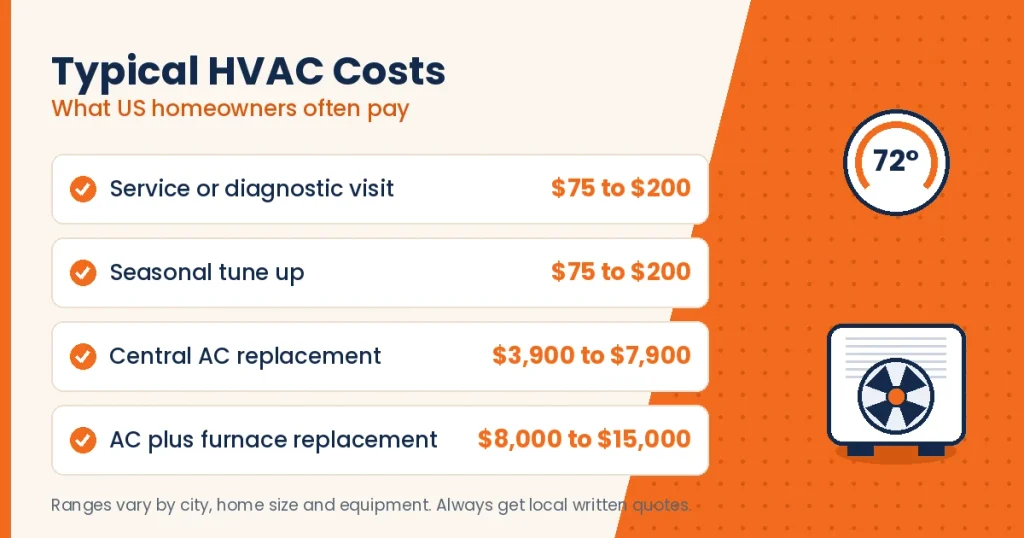
| Service | Typical cost range (USD) |
|---|---|
| Service or diagnostic visit | $75 to $200 [VERIFY] |
| Seasonal tune up | $75 to $200 [VERIFY] |
| Central AC replacement | $3,900 to $7,900 |
| Central AC plus furnace replacement | $8,000 to $15,000 |
| Ductless mini split (per zone) | $3,000 to $10,000 |
Emergency, weekend and holiday calls usually cost more than a standard visit. If you live in a large metro area or a high cost state, expect quotes toward the upper end of these ranges.
One more thing to know: the federal Energy Efficient Home Improvement Credit (Section 25C) ended for equipment placed in service after December 31, 2025. Your state, city or electric utility may still offer rebates, so ask your HVAC contractor which local programs apply to your new system.
What are the warning signs of a bad HVAC contractor?
Be careful with any HVAC contractor who won’t show a license, pushes you to sign the same day, quotes a full replacement without visiting your home, or asks for full payment before starting. These are common signs of a company that cuts corners or might not finish the job.
- No physical business address or a phone number that never gets answered
- A price far lower than every other quote
- Pressure to replace a system when a repair would solve the problem
- No written contract, or a contract with blank spaces
- Telling you a permit isn’t needed for a full system replacement
- Asking for cash only or the full amount upfront
When should you call an HVAC contractor instead of doing it yourself?
You can safely handle simple upkeep like changing filters, replacing thermostat batteries and clearing leaves away from the outdoor unit. Call a licensed HVAC contractor for anything involving refrigerant, gas lines, electrical parts, strange smells, or a system that won’t turn on after a basic check.
Do it yourself:
- Change or clean your air filter every 1 to 3 months
- Check the breaker and the thermostat settings before calling for service
- Keep the outdoor unit clear of leaves, weeds and snow
Call a professional:
- Ice on the refrigerant lines or the outdoor unit
- Burning, electrical or musty smells from the vents
- Loud grinding, banging or squealing sounds
- No heat in freezing weather or no cooling in extreme heat
If you smell gas, leave your home right away and call your gas utility or 911 from outside. Don’t switch lights or appliances on or off.
How do you find an emergency HVAC contractor near you?
Search for HVAC companies that list 24/7 or after hours service, then call two or three to compare arrival times and emergency fees. Ask for the price of the visit before the technician comes out, and save a trusted company’s number now so you’re not scrambling later.
On Search Acharya, you can check each listing’s hours and call straight from the page. If you’re in a big city, browse by location, such as local businesses in Houston, to find nearby companies that are open now.
Are you an HVAC business owner?
If you run an HVAC company, a complete directory listing helps local homeowners find and call you. Add your service area, hours, license details and photos of your work, and ask happy customers to leave reviews. You can list your HVAC business for free on Search Acharya, and every listing is reviewed before it goes live.
Frequently Asked Questions
How many quotes should I get from HVAC contractors?
Get at least three written quotes for any replacement or major repair. Three quotes show you the fair price range in your area and make it easy to spot a quote that’s too high or suspiciously low. For small repairs, one trusted company is usually enough.
Is the cheapest HVAC contractor a good choice?
Not always. A very low quote can mean lower quality equipment, no permit, a skipped load calculation or a short labor warranty. Compare what’s included in each quote, not just the total price.
Do HVAC contractors need a license?
Most states require HVAC contractors to be licensed, though some handle licensing at the city or county level. Technicians who work with refrigerant must also hold EPA Section 608 certification under federal law. Always check the license number with your state or local licensing board.
How long does it take to replace an HVAC system?
A straightforward replacement of an air conditioner and furnace often takes one to two days. Jobs that need new ductwork, electrical upgrades or a different system type can take longer. Your contractor should give you a timeline in writing.
How often should an HVAC system be serviced?
Most HVAC contractors recommend a tune up once a year for each system, ideally cooling in spring and heating in fall. Heat pumps run all year, so many homeowners schedule service twice a year. Regular service can also help keep your warranty valid.
What is the difference between an HVAC contractor and an HVAC technician?
An HVAC contractor is the licensed business that signs the contract, pulls permits and takes responsibility for the job. An HVAC technician is the trained person who does the hands on installation or repair. Many technicians work for a contractor rather than on their own.
Can I find HVAC contractors by city on Search Acharya?
Yes. Search Acharya lists local businesses across all 50 states and Washington, DC. You can browse by category or by location to compare HVAC contractors near you, along with their hours, phone numbers and reviews.
Find a trusted HVAC contractor today
Finding the right HVAC contractor near you comes down to a few simple checks: a valid license, proper certification, solid insurance, honest reviews and a clear written quote. Take the time to compare before you sign, and you’ll get a system that keeps your home comfortable for years. Start by browsing local service categories on Search Acharya.